


March - August 2026
Artsy Art Fair
Women Led Galleries and the Women Artists they Champion
Online Exclusive Exhibition
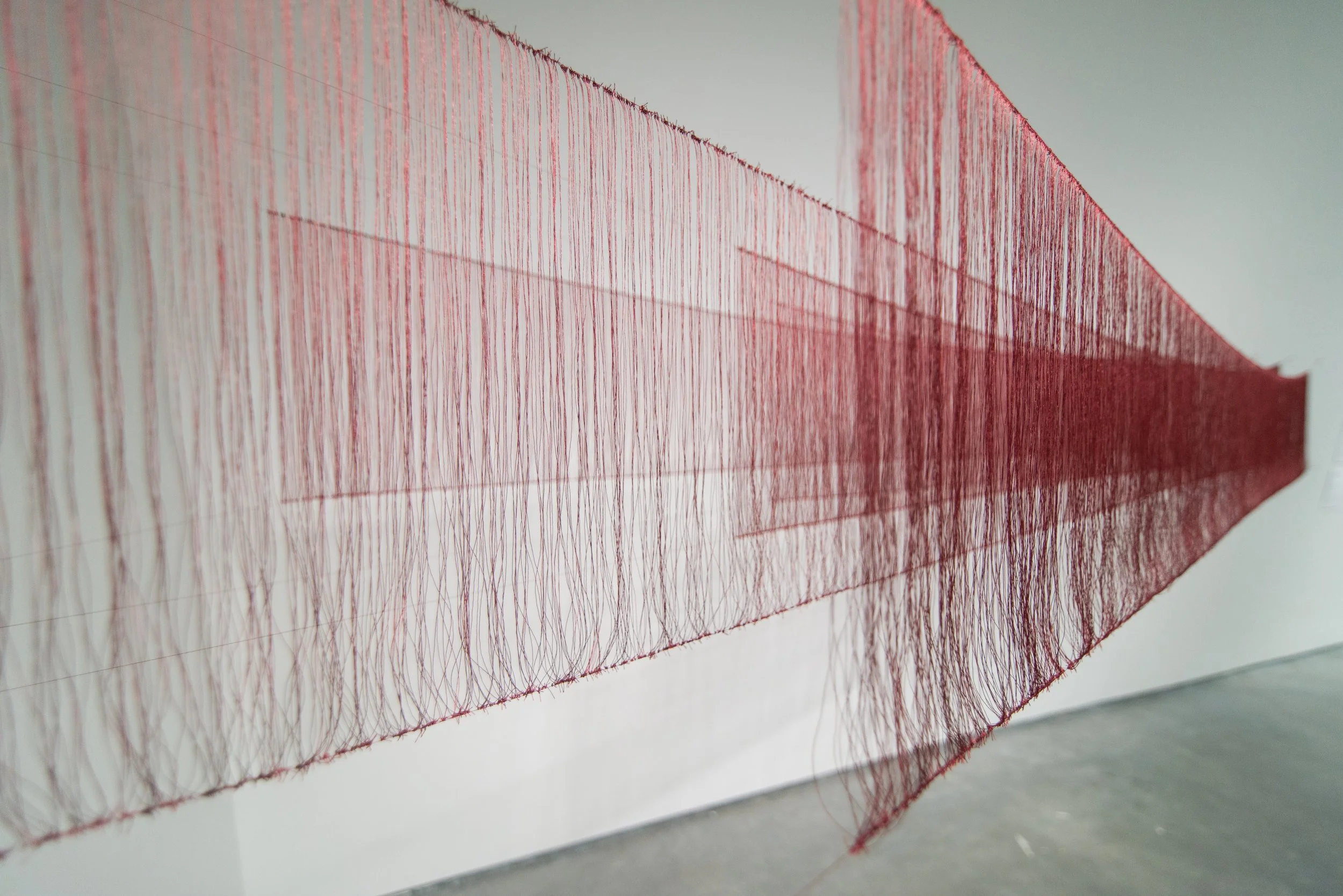
Installation view of 6359, 8718, 11284, 4531, 9143 by Katie Lewis. Thread, dimensions variable
Out of Line brings together fifteen artists, all women whose practices expand drawing beyond the page, challenging the notion of the line as obedient boundary or preparatory act. Featuring work by Lisa Jarrett, Jennifer Garza-Cuen, Julia Schwadron Marianelli, Miya Hannan, Eunkang Koh, Jean Brennan, Frances Melhop, Claire Scully, Hanako Miyamoto, Sophie Scott, Megan Winegardner, Victoria Wagner, Katie Lewis, Barbara Holmes and Kelly Chorpening, the exhibition foregrounds drawing as material, action, and spatial intervention.
Across media including fiber, installation, performance, digital processes, ink, and architectural intervention, these artists activate the line as structure, gesture, trace, and presence. Thread becomes duration. Graphite becomes index. Light becomes form and sculpture becomes fragile and skeletal on the verge of collapse. Rather than treating drawing as a preliminary step toward another medium, the works on view position it as a fully realized and critically charged practice in its own right.
By enlarging, interrupting, layering, and recontextualizing the mark, Out of Line questions inherited hierarchies that have historically constrained the definition of drawing. The exhibition reframes the medium as elastic and porous, capable of occupying walls, bodies, and space itself. What emerges is not a single expanded definition but a dynamic range of approaches that assert drawing as a site of experimentation, resistance, and embodied inquiry.
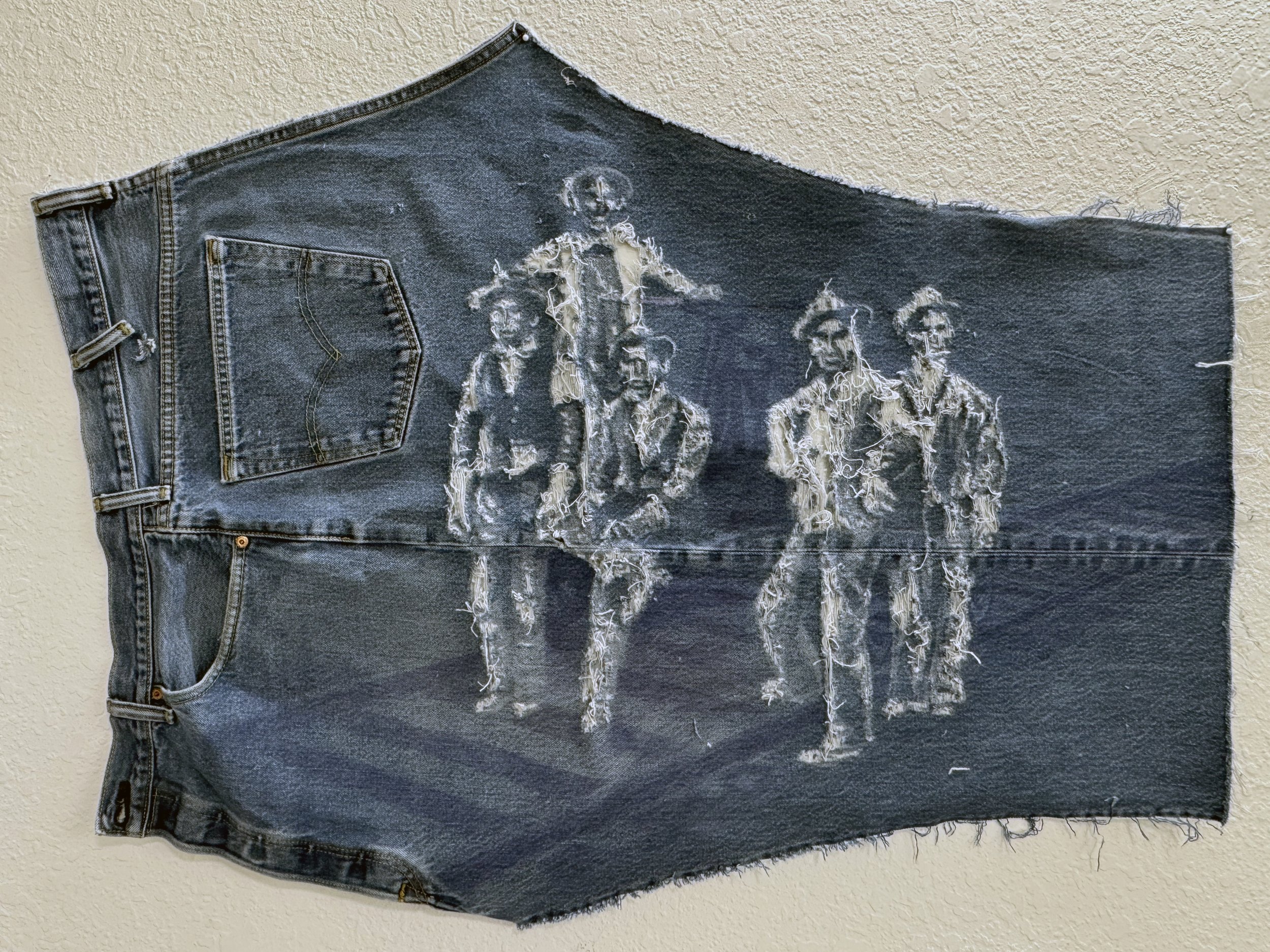
Embodied Wear #2. Miya Hannan. Rotary tool and textile paint on denim, 28 × 36 in 2026
Artist Statement
MIYA HANNAN
“Embodied Wear” is part of the Crossing the Ocean project, a body of work that uncovers the obscured stories of Japanese railroad workers who migrated to the Intermountain West of the United States around 1900. The images are carved into the surface of denim based on historical photographs. The notion of a monolithic American identity is a constructed myth; the nation was built through the labor of diverse communities whose contributions have been systematically marginalized or erased. In this work, the workers’ images emerge through holes and tears in the jeans, signifying both the physical toll of their labor and the erasure of their histories.
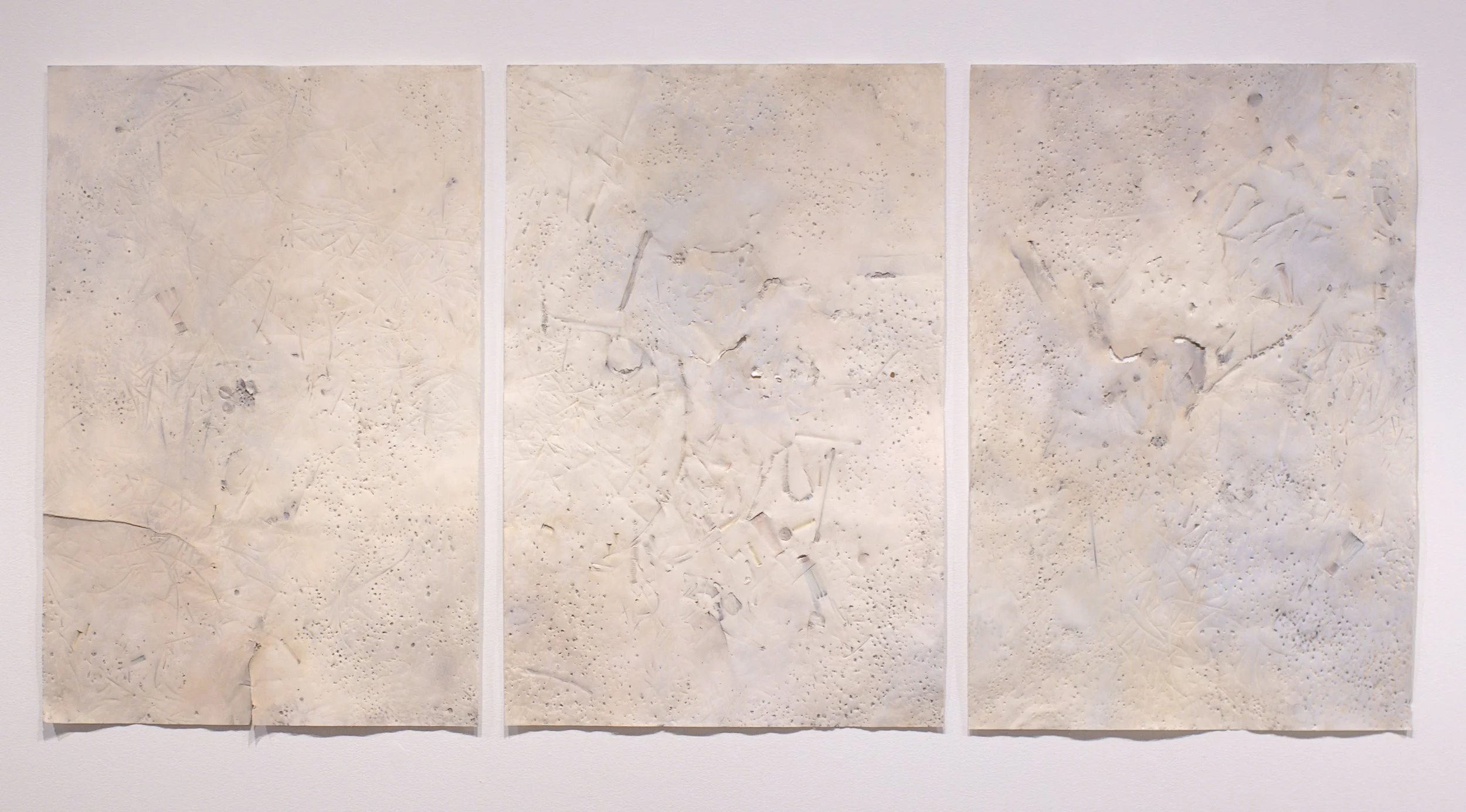
View of the ornate and woe-begotten, Kelly Chorpening. Acrylic paint, pastel and graphite on paper, triptych, 39.5 x 26.25 in. each, 2026. Photo by Lily Sommerfeldt
Artist Statement
KELLY CHORPENING
For me drawing is a means to observe, and walking is central to my approach. Being out in nature, there is a tension between spectacular views and what is viewed when looking down as feet move across uneven terrain. ‘Nature’ has revealed itself to be a mixture of natural objects such as rocks, sticks and pine needles, as well as broken bottles, bullet casings and car parts; an unsettling reality of man-made materials enmeshed in places they should not be. In some work, objects are collected and assembled into dynamic configurations that are drawn in hyper detail. Other work involves embossing paper on the ground outside and drawing in relation to that direct trace of the ground’s actual composition.
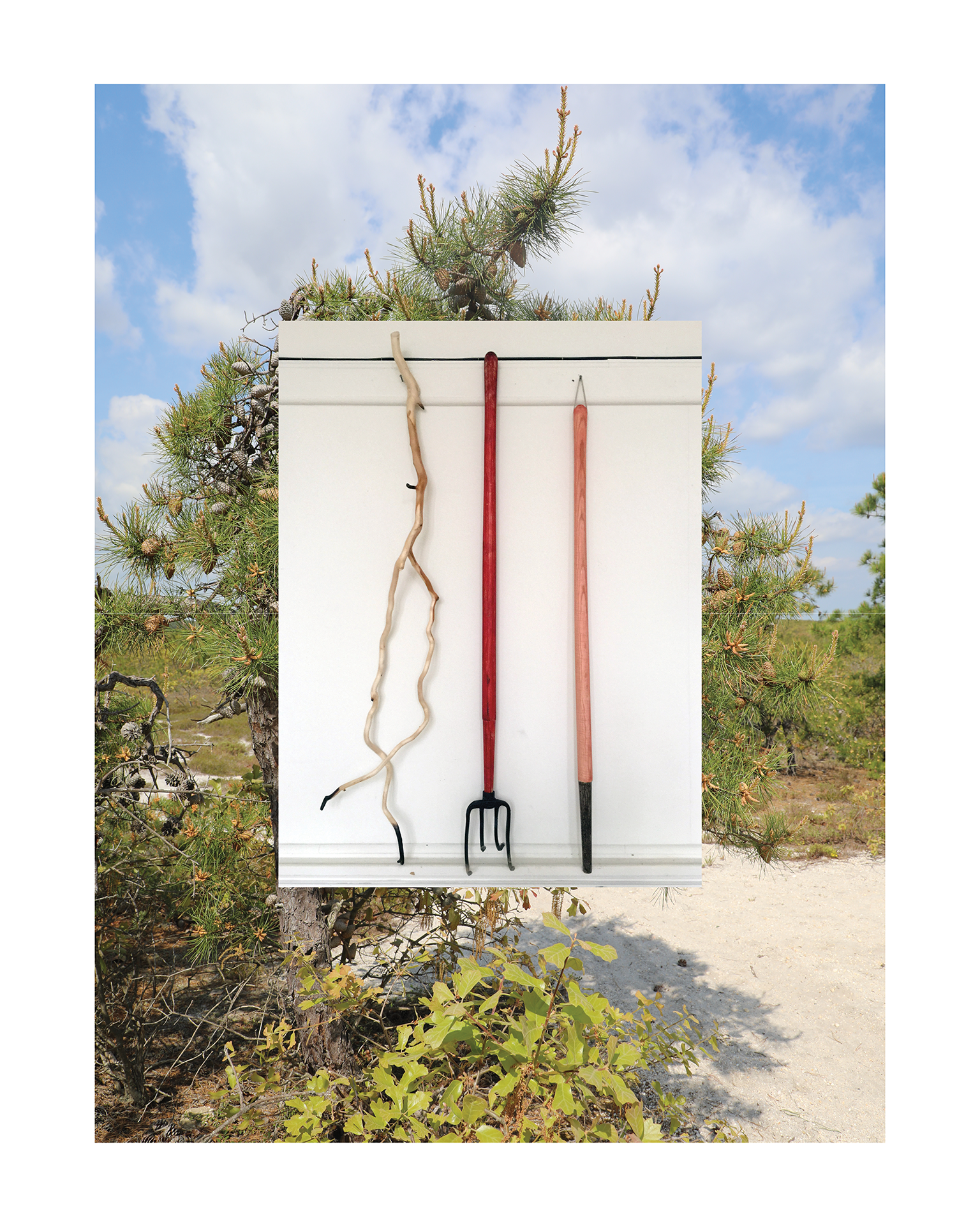
Tools for Excavating Virgin Snow, Jean Brennan, Edition of 10, 20” x 16” CPrint, Fujicolor Crystal Archive paper.
Artist Statement
JEAN BRENNAN
This research includes a social and ecological field guide, documentation of a durational action, and a set of assembled tools. The walk traced the perimeter of an aerial bomb training site, located in an ecologically rare dwarf pine plain, during the season’s first snow. A small video camera strapped to the back of my head captured a receding landscape and the mark-making action in video. The field guide includes an essay, project documentation, and images that register how areas of the Pinelands have been deemed ’sacrificial zones’ (Naomi Klein) despite their ecological significance. The project began with an excavation of personal and family memories related to the New Jersey Pine Barrens.
—Jean Brennan
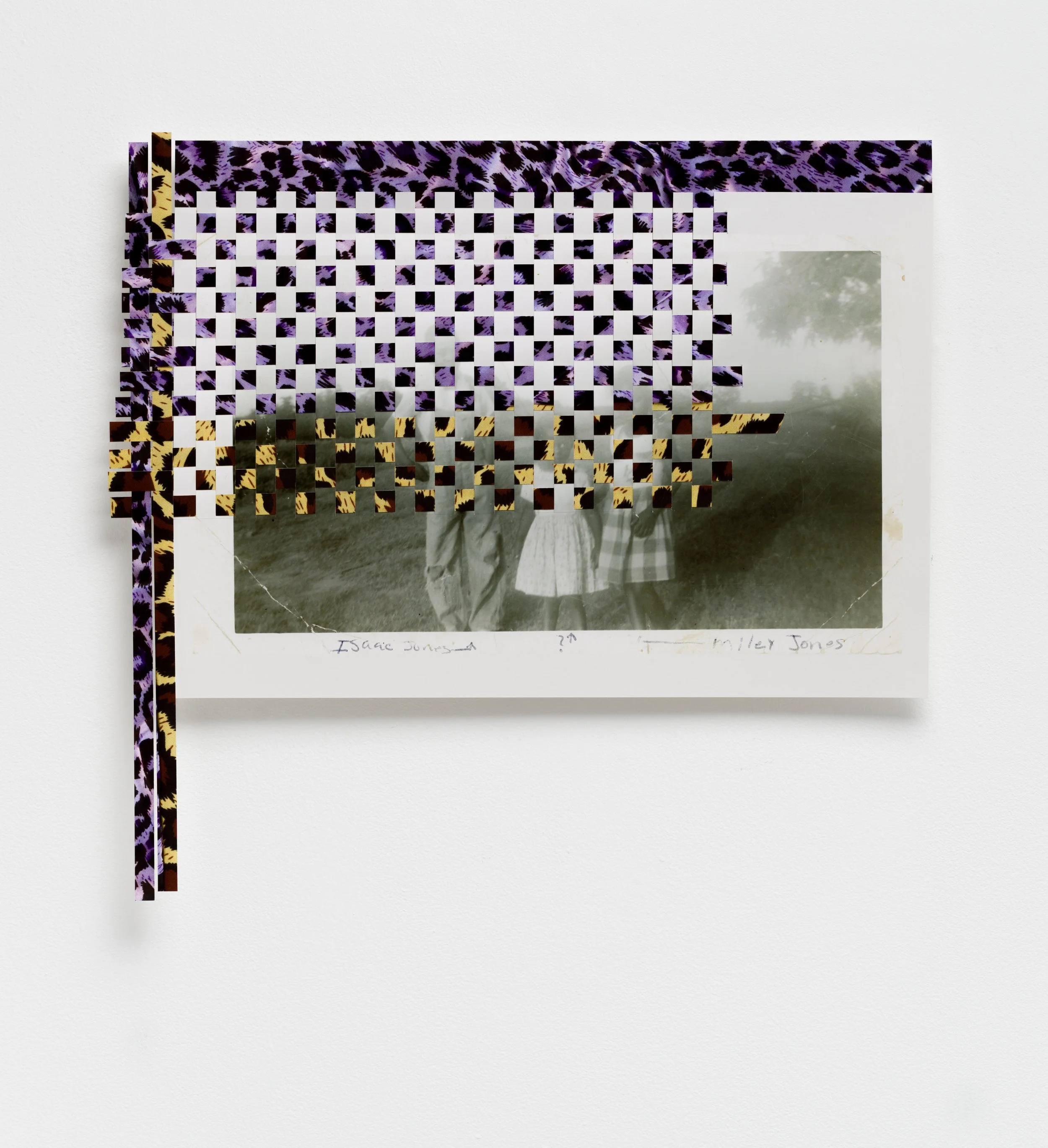
Phenotyped (Isaac Jones, ?, Miley Jones, and Auntie Velva; Pinwheel: Pink Leopard Print and Red Sparkle Head Scarves), 2025. Lisa Jarrett. Woven paper pigment prints (Family photographs woven into photographs of scarf display at Elegant Beauty Supply in Florida) 19.5 x 20.75 in
Artist Statement
LISA JARRETT
12 drawings about signs about drawing (Love is everywhere):
Stop
Go
Merge
Yield
Exit
Dead end
Detour
Do Not Pass
One way
Wrong way
Cross here
Do Not Pass
Lisa Jarrett Out of Line Statement 2026
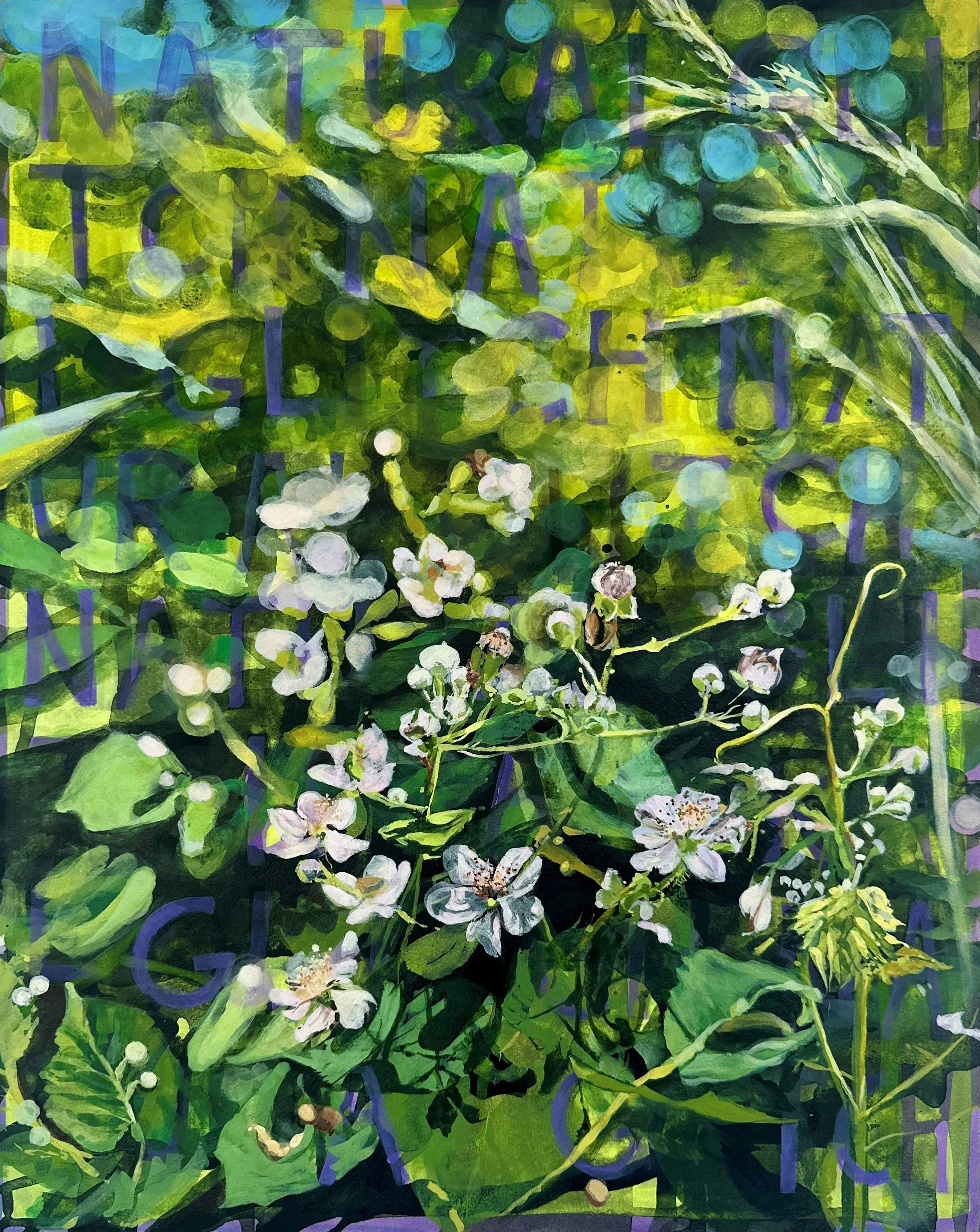
Natural Glitch, Julia Schwadron Marianelli. Acrylic ink on paper on board, 2025. 20” x 16”
Artist Statement
JULIA SCHWADRON MARIANELLI
I often begin a painting with a text phrase that serves as both title and point of departure—language that bridges the natural environment and the human psyche. One work, Suppression Tactics, emerged while reflecting on escalating wildfire conditions in the American West alongside the systemic ways vital information is withheld from those who need it most.
By layering and weaving text through the landscape, the painting becomes a site of contemplation and transformation. I think of the textual layer as the initial skeleton of the composition: a structural drawing that guides the image as it evolves. The words are meant to be both read and seen—at times visible, at times buried—mirroring how language can simultaneously reveal and obscure meaning.
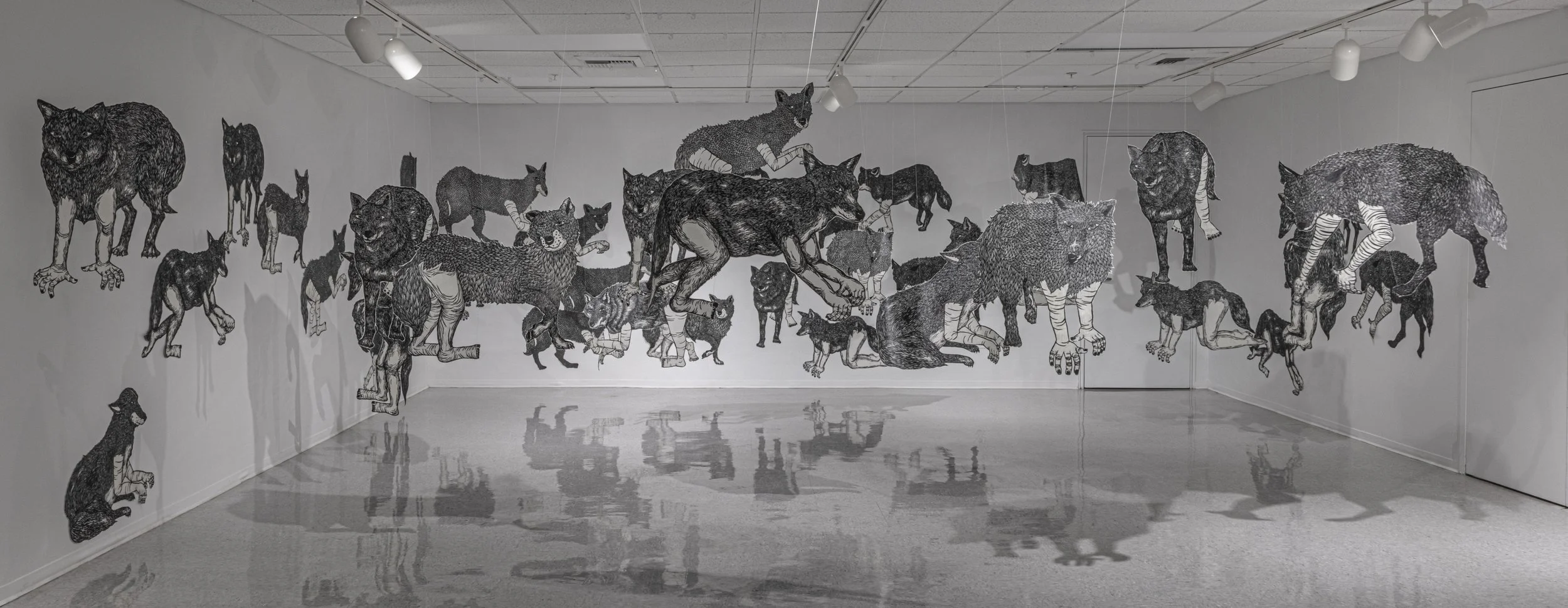
Primal Urges: Coyotes, Eunkang Koh. Relief prints on hanji and beeswax, 224 inches x 238 x144 inches, 2024
Artist Statement
EUNKANG KOH
I see drawing as a way of mark making. Each mark, whether carved, painted or sewn, reflects the process of accumulating traces of my thoughts and ideas.
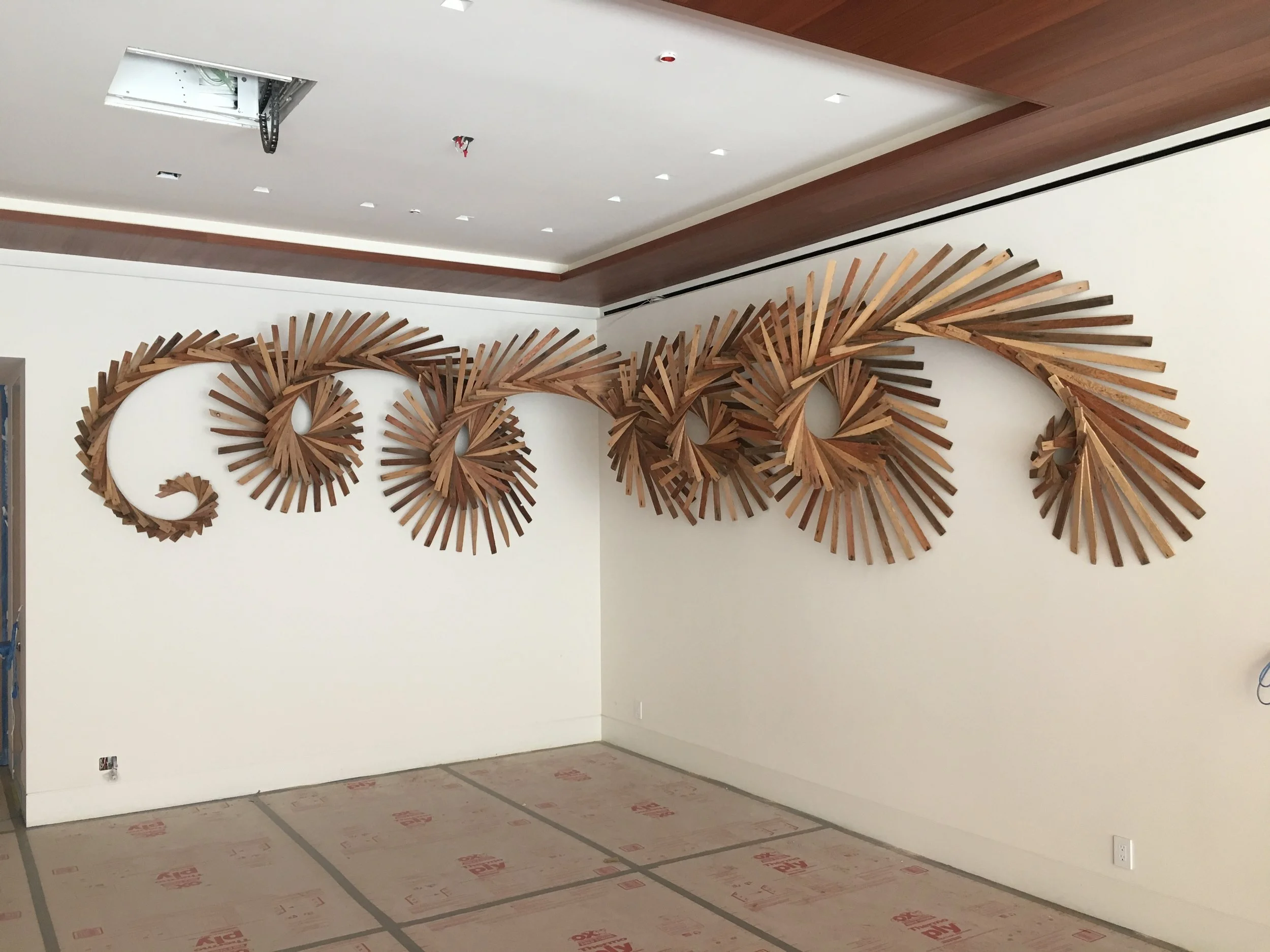
Atherton Residence, Barbara Holmes. Reclaimed lathe, 30 feet length, variable height and depth. 2017.
Artist Statement:
BARBARA HOLMES
My work treats the line as something sensed before it takes form, an impulse that becomes real only through the act of making. It is a means of reconfiguring space while also cultivating sustained, meditative attention. Whether through installations or prints, I aim to create environments where viewers encounter drawing not as a flat mark, but as a lived experience rooted in an ongoing act of attentive looking.
When building with reclaimed lath, I think of each strip of wood as a line released into space. As I assemble these pieces, they accumulate into a kind of spatial drawing—lines that curve, ripple, and climb through the room, spiraling and fanning across walls and floors. Instead of confining a gesture to paper, I let it travel outward, allowing the room itself to become the drawing surface. Working intuitively, I follow the material’s cues—its bends, fractures, and patinated surfaces—so that the line’s path is shaped as much by attentive seeing as by making. In this way, constructing the installation becomes a deliberate, patient act of observation, where each adjustment refines how the drawing moves through space.
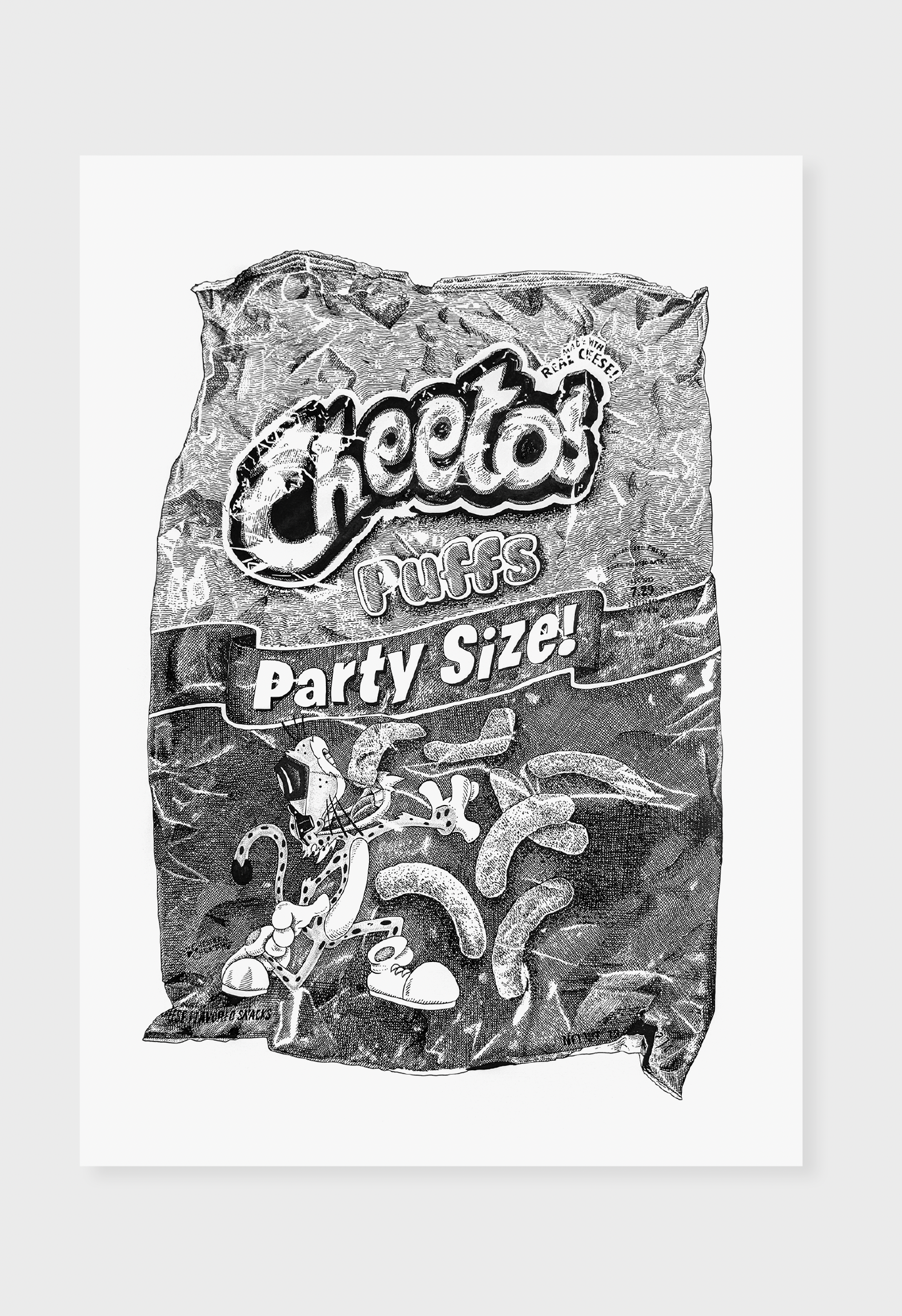
Cheetos Party Size, Claire Scully. Pen and Ink drawing on Lambeth Cartridge Paper, 27 14/25inches × 19 69inches, 2026
Artist Statement
CLAIRE SCULLY
Time.
Labour.
Attention.
Scale.
I use traditional drawing methods to elevate materials that are culturally considered low status. A tension between labour and disposability lays at the centre of this work. Drawing is slow, it requires patience, endurance, and control. There is something quietly powerful about applying a sustained and committed labour to things that culture deem is worthless.
This is not rubbish.
It is evidence..
PROCESS
I am process driven in terms of control, observation, precision, scale manipulation and reproduction. Experimentation doesn’t appear as material chaos more as conceptual restraint, deliberate restriction as strength.
I draw, I draw realistically, I draw from observation, I draw specific kinds of objects, I enlarge them, I focus on them. I don’t dramatise them, I don’t distort them and I don’t embellish them. I do not experiment by adding more variables, I experiment by removing them. The scrutiny of the object itself.
I apply high-level craft to low-status material and refuse to dramatise it. The refusal is the experiment. I work within a deliberately narrow set of parameters. The drawings are observational, controlled, and materially straightforward.
The challenge lays in what happens when scale and attention are applied to objects that are culturally insignificant.
Everything is consumed so quickly now - food, fashion, objects, images, information. Drawing slows everything down. Acceleration with no limits is unsustainable. Pausing for thought, reflection and resetting the speed for a more considered rate of consumption is central to the way I make work.
Drawing is the mode of transport for a concept, a vehicle to take the viewer into a world of isolated introspection. I don’t ask what drawing can do, more, ‘What happens if I treat this object seriously?’. I work with constraint, traditional medium, controlled technique, ordinary subject, enlarged scale, no spectacle.
It’s a discipline.
RECLAIMING ATTENTION
30 second consumption object and give it 30 hours of labour.
Within the attention economy*, speed is rewarded. My work insists on duration. In a culture shaped by rapid scaling and engineered distraction, attention has become both scarce and valuable. Drawing operates in opposition to that tempo. Drawing demands time both in the making and in the viewing, and in doing so challenge the disposability of the objects being depicted.
The crushed can is the ultimate end point of consumption. The drawing is the starting point for contemplation.
A transformation of the aftermath of speed into a place of duration.
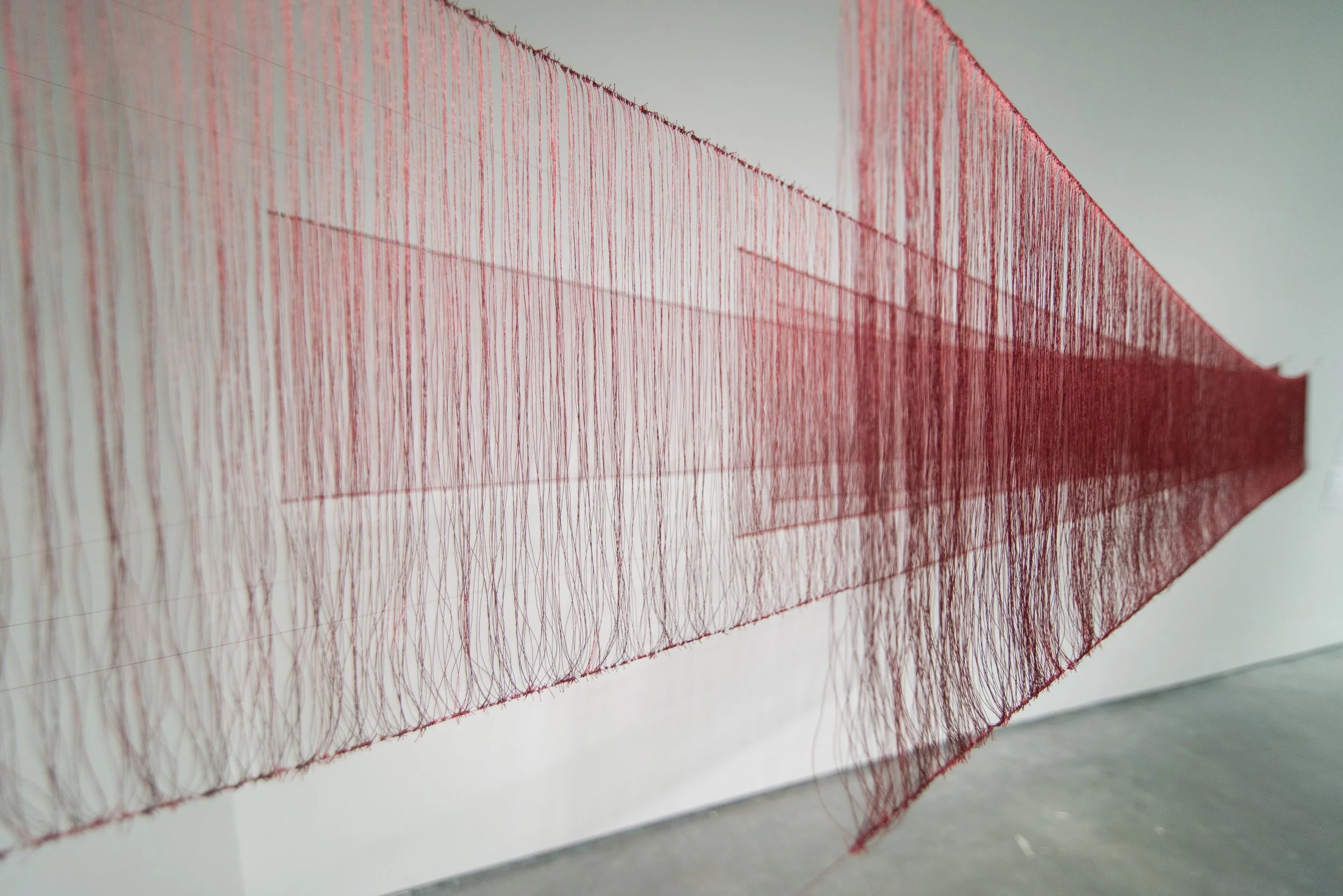
Installation view of 6359, 8718, 11284, 4531, 9143 by Katie Lewis. Thread, dimensions variable
Artist Statement
KATIE LEWIS
Whether the work is on paper, the wall, or in three-dimensional space I view all my work as drawing. By using limited materials for each piece such as paper, thread, sewing pins, or graphite combined with repetitive actions within a system, the materials begin to transform into complex accumulations of visual information. The pins amass on the wall into clusters or swarms, the thread weaves through the pins eventually becoming a chaotic web, graphite numbers compile into a black mass, and holes drilled into paper or a wall begin to grow larger. I am interested in how a controlled set of repeated actions can eventually lead the system to reach a breaking point—the paper begins to tear or is eaten away by the number of poked holes, the wall starts to crumble, and the thread buries the pins beneath it’s web. The rigidly controlled structure begins to collapse through seemingly benign and inconsequential actions creating unpredictable results.
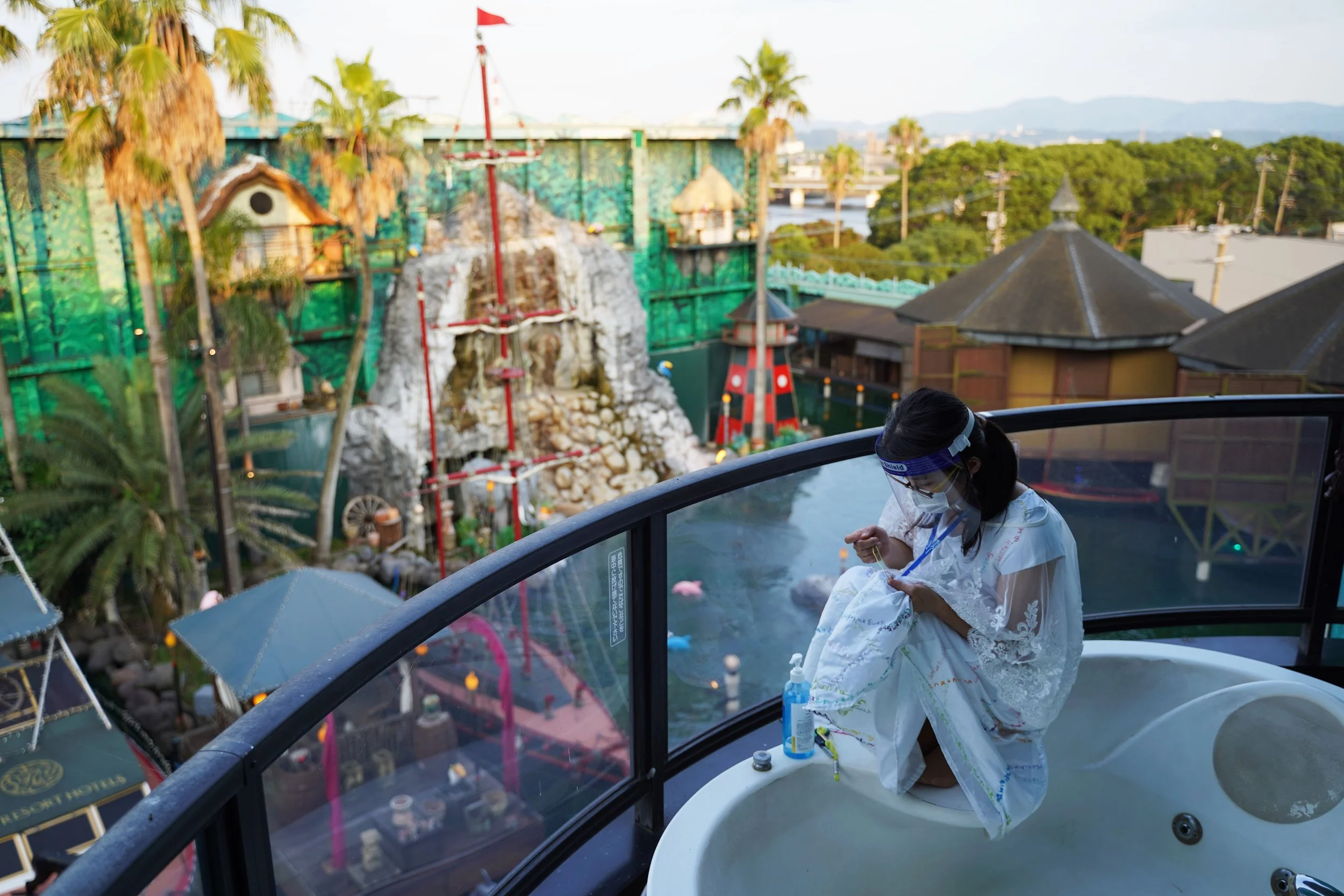
White Fades Away #1. Hanako Miyamoto. Archival Documentation Photographs of Performance Work by Hanako Miyamoto. Archival Pigment Print, Hahnemühle, 20 x 30 inches with 2” border, unframed, edition of 10 + 2 AP 2016-2016.
Artist Statement
HANAKO MIYAMOTO
I create works that focus on the theme of other people, namely family.
Diaries are embroidered onto wedding dresses.
The diaries are written in places where a certain amount of time has been spent.
This project began in 2016, and with each new diary entry, the white of the dress fades away.
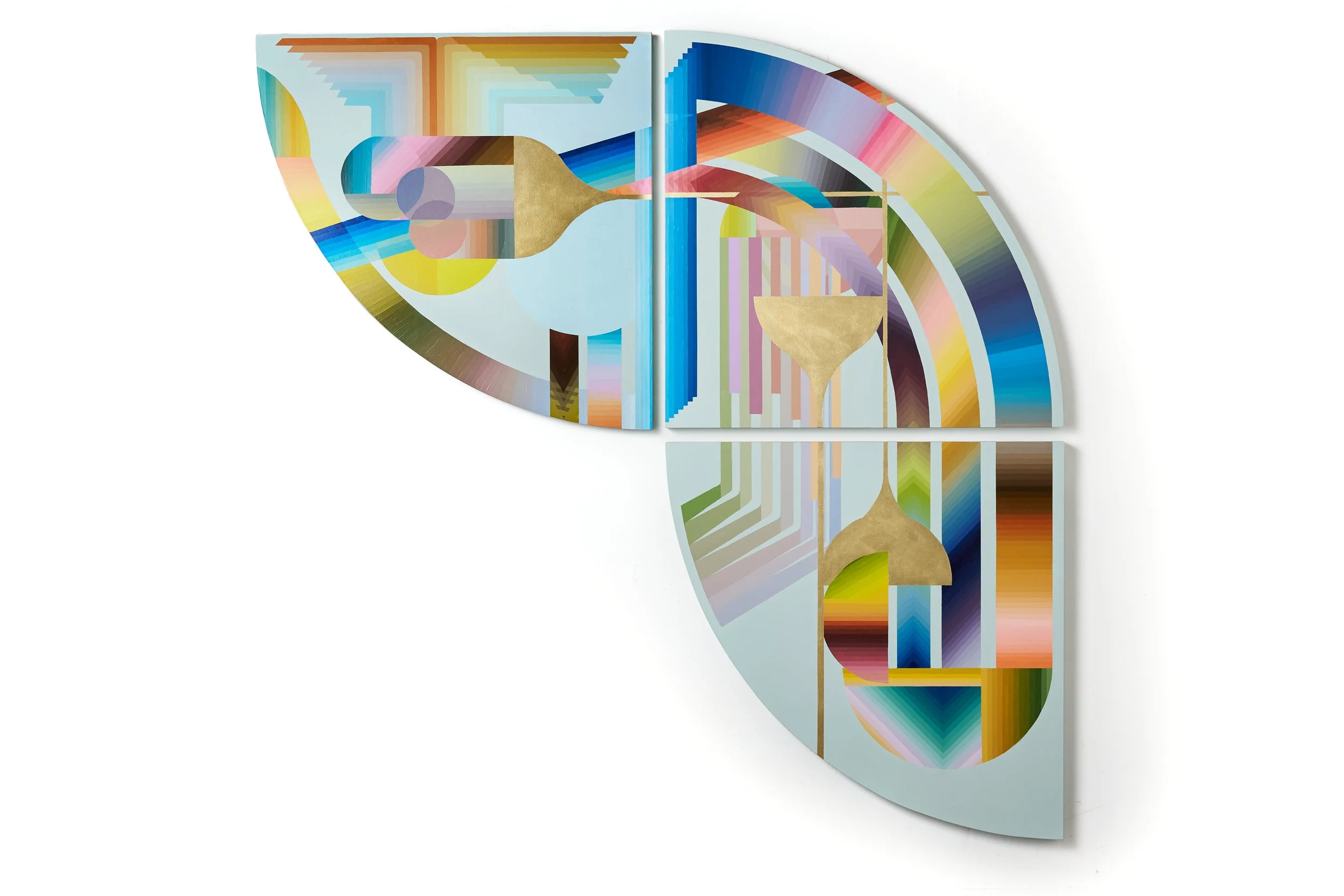
Come the Bells, Victoria Wagner. oil and gold mineral powder on wood panel, 84"x84", 2024
Artist Statement
VICTORIA WAGNER
On Drawing
The line initiates all of my work. Whether sculptural of pictorial, the act of drawing is central to and a driver for the process. A graphite drawing on white and blue grid paper is the starting point for all of my painting alongside the tools that I enjoy; various rulers, compasses and erasers.
Through many iterations, the process of drawing and re-drawing helps me find the elusive composition that occurred in my imagination.
Once it is captured on grid paper it is then drawn again onto a transparent film to be broadcast in larger scale using a very remedial overhead projector. The projector (such a lovely tool) helps me to see the many compositional variations. Through tiny shifts of magnification, direction or orientation, the scale, proportions and ultimately the composition arrives at a unique place.
It is once again altered by the process of drawing in transferring the composition onto the wall, canvas or panel. It has then become a new drawing but also a template that will explore hue, tone, pattern and sheen on its way to becoming a painting.
In similar and differing ways, I take up the activity of working the line on wood with my chainsaw on wood, creating not an outline but a boundary between form and space. The saw simultaneously reduces the form while it adds negative space. Like drawing with an eraser each pass with the saw adds more environment to the composition inviting the light and shadow to reveal dimension within the form.
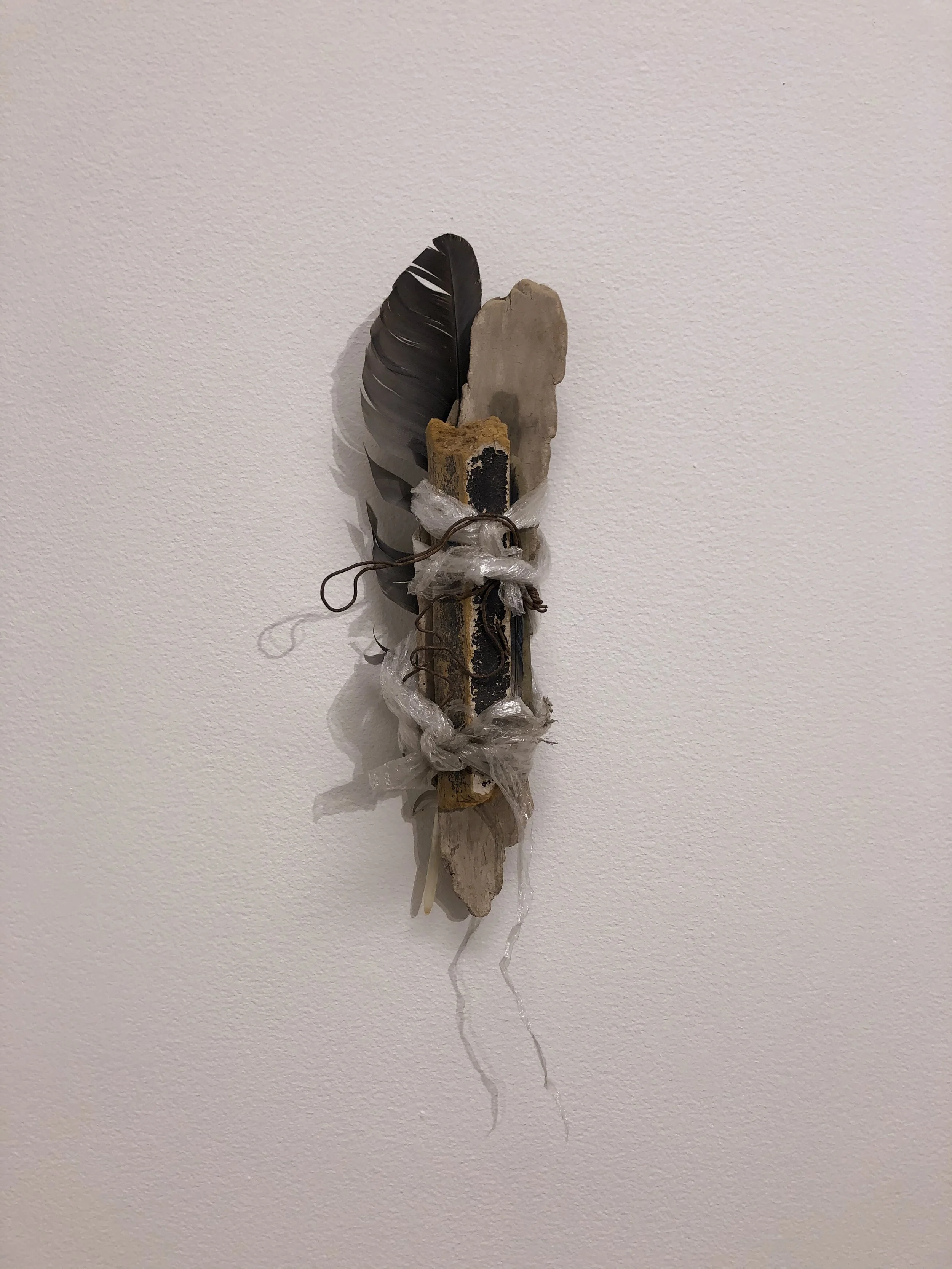
“icons: a sentence i can’t remember the end of” Megan Winegardner (2020). Approximately 14” x 5,” collected found materials.
Artist Statement
MEGAN WINEGARDNER
My work focuses on the tangible residues of lived experiences, and I seek to attune perception toward objects as conveyors of material remembering. In my practice collected items tell of the past in a silent, wordless language, expressing their memories through the patina and fragmentation of their surfaces as they communicate the fragile and visible nature of recollections
Collected objects—layered, related, bound together—exist as a record or study of the traces left by corporality. Within their fragmentation and fray, marks, tarnish and wear, exists a polyphonic drawing of the reified past.
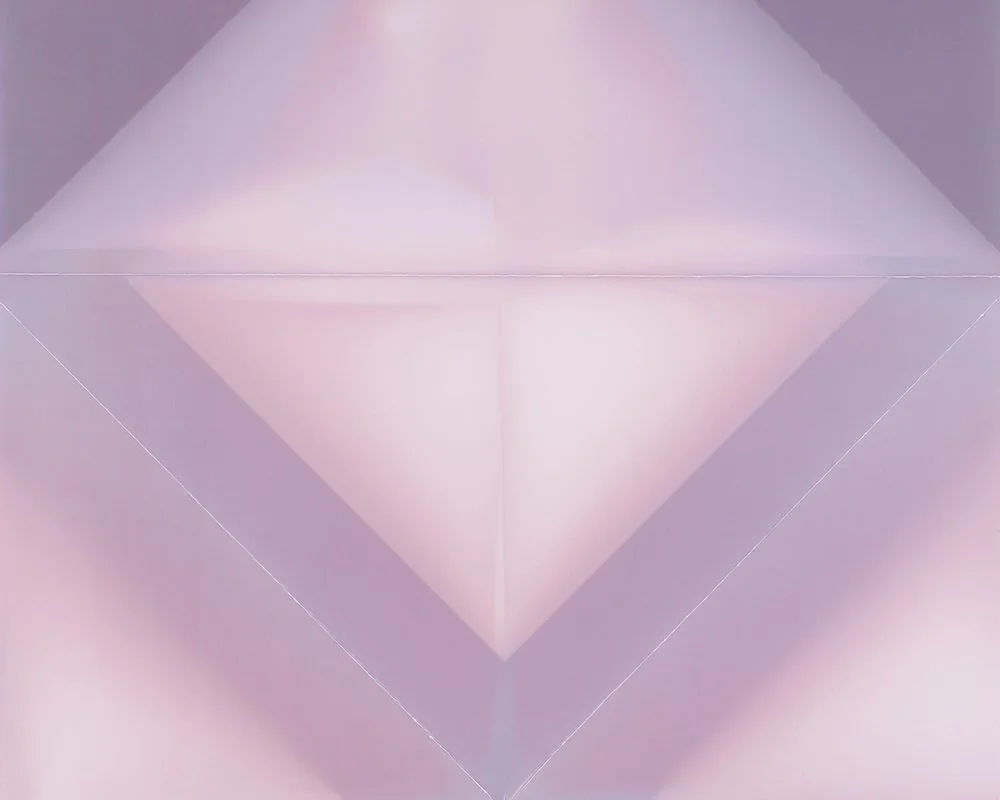
'Pink Parts & Other Gorgeous Nothings' PPOGN #6, Jennifer Garza-Cuen. 50"x 40" Edition of 7 +1AP. Archival prints on Canson Platine Fibre Rag.
Artist Statement
JENNIFER GARZA-CUEN
Fold / envelop / lick and seal / a pale tint of red / non-existent // cover / enclose / words of injuries translated / A821 // to be involved in / within and without / entrances and exits / of a color intermediate between red and white // Mn2+/ holding moderately radical socio-political views / arrivals of departures / hysteria / to be moved emotionally / tickled / cut / to perforate / pink justice // pick / pierce / puncture / wound // a surgeon’s knife / circularly diagonal rectangles / layered / terra cotta / covers / sheets / paper on paper / a containing structure // light / bluish red hues / +1 Ag+ / concealing and revealing / intimacies / body and mind / violent exhaustion / thin and flat / rosy / ultra violet / halides of silver in four-flap arrangements // rolls of flesh / exposed scrolls / light-stained / undeveloped // 255, 192, 203 / fragments of fixed impermanence / mute tellers of providence // AgX / compound chemical / within and without / across the contours of open wounds / between red and white / in the absence of something // a color / folded / enveloped / sealed and licked

Common Threads 7, Frances Melhop. Monotype ink on BFK Rives, with cotton embroidery, 60” x 36” 2024.
Artist Statement
“Common Threads”
FRANCES MELHOP
Throughout my career, I have made narrative visual stories about women, for women. Inspired by teaching history of artists/activists Gentileschi through to Guerrilla Girls, my instinct is to continue contributing to their reframing of history, amplifying female voices within the art canon.
Recently I researched the advances for women made by the early Feminist artists and how the overturn of Roe versus Wade in 2022, suggests we might be moving backwards, losing some of their hard-won victories. The stitched figures are a salute to the 1960’s - 1990’s Feminist artist icons who used their bodies as material creatively and artistically to break down barriers, taboos, restrictions, oppressive systems, and ideologies.
A recent series, Common Threads, consists of simple pressure prints of dresses overlaid with embroidered contour drawings of female bodies. As a photographer and multidisciplinary visual artist, I am attracted to the photographic X-Ray quality of the dress imprints and the interplay of multiple perspectives, eye games between the ghostly print and the contour stitching of the liberated figure that is not enclosed by the dress, using nakedness and vulnerability as contemplative tools of resistance.
Overall, my mission is to slow down, preserve and celebrate human touch, materiality, physical realities and honor the memories embedded in each garment. Referencing these artists and their performances reminds me of the importance of questioning imposed standards and the accepted status quo, of following our own creative vision, and standing up to injustices in any little ways, while accepting ourselves as we are.